An AI Spokesperson, a “Chinese Spy,” and Trump: How an Extramarital Affair Compromised U.S. Security
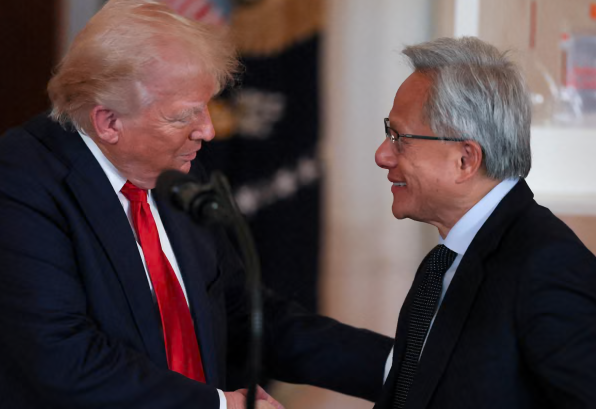
Jensen Huang’s close ties to the U.S. president mean that an alleged extramarital affair between the Nvidia CEO and a woman said to be based in Beijing is coming under close scrutiny.
A hand resting on a back, a kiss planted on a cheek—at first glance, the interaction between Huang Ailing and Jensen Huang during an event in Taipei last year might not have seemed particularly noteworthy.
However, the revelation on Sunday that the two were involved in an affair has cast the incident in a new light.
According to reports, the woman—who is not a relative of Huang—is not only an executive at a company that is a client of Nvidia, but has also been accused of being a Chinese spy.
Nvidia has launched an independent investigation into reports that the head of a company central to the global artificial intelligence boom has become a target of a foreign intelligence agency.
“While the board has no reason to believe that national security or Nvidia’s confidential information has been compromised, the board’s investigation will examine all available information,” the board stated.
Jensen Huang, 63, often seen in his signature leather jacket, stands as one of the defining figures of the artificial intelligence boom. He acknowledges that there are “no excuses” for anything he has done.
Beyond the damage to Jensen Huang’s personal reputation, what is the extent of the harm caused to Nvidia and U.S. national security?
Last year, The New York Times and Bloomberg raised questions about a Singapore-based buyer that had been purchasing Nvidia’s high-performance chips—the essential “shovels” in the current artificial intelligence gold rush. There were concerns that the firm, Megaspeed, might be circumventing U.S. export restrictions on AI chips to China by diverting some of its Nvidia inventory to the United States’ primary rival. Both Nvidia and Megaspeed have denied these allegations.
Last month, The New York Times published a bombshell report alleging that Jensen Huang had developed a “close relationship” with an executive at Megaspeed named Alice Huang—an individual whom U.S. officials believe to be a Chinese intelligence operative. Donald Trump, who was informed of this at the time, chose not to take any action. It now appears that their relationship was far more than merely “close.”
The question of what China may have gained through Alice Huang lies at the heart of a deeply concerning connection involving the CEO of the world’s second most valuable company and the President of the United States.
On Monday, The New York Times reported that Nvidia appears to have successfully pressured the U.S. Department of Commerce to block an investigation into Megaspeed’s alleged smuggling of chips. This pressure reportedly came from a Trump-appointed official, who facilitated communication between Nvidia and the Department of Commerce regarding the case.
In response to last year’s reports concerning the potential diversion of Nvidia product shipments, Megaspeed stated: “Megaspeed is a Singapore-based company that operates in full compliance with all applicable laws, including U.S. export control regulations.”
Since the beginning of Donald Trump’s second term, he has met with Nvidia CEO Jensen Huang at least seven times. Huang has traveled aboard Air Force One on multiple occasions and has even taken calls from the President while in public.
Four of these meetings touched upon one of the most sensitive issues in U.S.-China relations: American export controls on the world’s most advanced artificial intelligence chips—products sold almost exclusively by Nvidia.
Under the administration of former President Joe Biden, the U.S. implemented the CHIPS Act, a set of regulations imposing broad restrictions on American technology companies and their overseas trading partners. These rules are designed to control which semiconductor technologies U.S. firms can sell to foreign entities—specifically targeting companies that might face pressure to transfer such technology to China.
The policy also introduced stringent licensing requirements, which in turn limit how these partners can utilize the technology they purchase.
For Nvidia, this was undoubtedly a case of “adding insult to injury.” China is one of its largest markets for GPU chips, accounting for approximately one-quarter of the company’s revenue between 2020 and 2022. Following the passage of the CHIPS Act, Nvidia began selling “downgraded” versions of its high-end chips—such as the A800 and H800—to the Chinese market. However, some of these chips were subsequently banned, leaving Nvidia in an even more difficult position.
The situation shifted during the Trump administration. Just six days into his term, Trump invited Jensen Huang to the White House to discuss artificial intelligence policy and chip exports. The two met again in July and August 2025. Subsequently, Huang secured a series of wins: Trump permitted Nvidia to export previously banned chips to China. In exchange, Nvidia agreed to remit 15% of its sales revenue to the U.S. government.
Experts suggest that this agreement will help Beijing compete at the “frontier of artificial intelligence”—in other words, to develop AI systems capable of rivaling those produced by companies like Anthropic and OpenAI.
Five months later, just days after another meeting with Trump, the tech giant appeared to secure a striking concession. The president agreed to allow the company to export its H200s—a more powerful type of chip—to China, in exchange for a 25% share of the proceeds.
“President Xi Jinping responded positively!” Trump wrote on Truth Social.
It is not unusual for major tech companies to lobby Washington to advance their preferred policies; nor is it unusual for Trump to grant opportunities and preferential treatment to those he favors.
But another fact has now become clear: during a pivotal year for his company, Jensen Huang maintained a close relationship with an individual alleged to be a Chinese spy. The two were first photographed together in mid-2024—five months into Trump’s presidency—at a restaurant in Taipei. This occurred at the height of Huang’s lobbying efforts, shortly before Trump authorized Nvidia to sell its H200 chips to China.
What kind of information did Alice Huang—the individual in question—manage to gather and pass on? A great deal. She gained insight into the U.S. policymaking process, as well as Trump’s own erratic thinking regarding artificial intelligence. She may well have also obtained a wealth of insider information from outside the White House.
Jensen Huang has played a key role as governments around the world formulate their AI policies. That year, he met with world leaders from South Korea to Saudi Arabia; he also appeared on stage in London alongside Keir Starmer, who was then the British Prime Minister.
He was undoubtedly privy to the details of the most critical technology policies—AI development roadmaps—of many governments, given that his company is often the only one capable of realizing these objectives. This was especially true in the case of the United Kingdom.
Despite the remarkable intellectual feats achieved by systems powered by Nvidia’s technology, it is Jensen Huang’s own human intellect that has proven most valuable to America’s competitors.